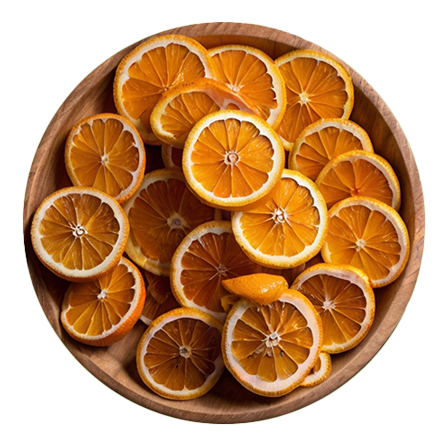
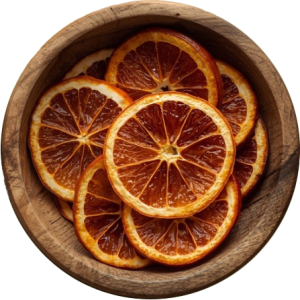
Dried oranges are slices or peels of orange that have been dehydrated to remove moisture.
Nutrient
Amount per 100 g
Calories
284 kcal
Carbohydrates
69.4 g
Sugars
59 g
Fiber
7.8 g
Protein
4.1 g
Total Fat
0.8 g
Vitamin C
42 mg (about 47% of the Daily Value)
Calcium
90 mg (about 9% of the Daily Value)
Iron
0.7 mg (about 4% of the Daily Value)
Potassium
782 mg (about 22% of the Daily Value)
Saturated Fat
0.1 g
They are commonly used for:
Decorations: Popular during the holiday season for wreaths, garlands, and ornaments.
Cooking/Baking: Adds a tangy citrus flavor to desserts, teas, and marinades.
Snacking: Eaten as a healthy, chewy snack.
Crafts: Used in potpourri or handmade products.
You can make them at home by slicing oranges thinly and drying them in an oven at a low temperature (around 65–90°C or 150–200°F) for several hours.
Applications
Dried orange can be used as raw material in a variety of industries due to its aromatic, nutritional, and decorative properties. Here are some applications:
Food and Beverage Industry
Flavoring: Dried orange peels or slices can be ground into powder and used as a natural flavoring in teas, desserts, or baked goods.
Infusions: Used in cocktails, herbal teas, or syrups for a citrusy aroma and taste.
Snack Production: As a chewy, healthy snack or mixed into trail mixes.
Marmalades and Sauces: Rehydrated and used in making preserves or citrus-based sauces.
Cosmetics and Personal Care
Exfoliants: Dried orange peel powder can act as a natural scrub in face masks and body washes.
Essential Oils: Extracted for use in perfumes, creams, and lotions.
Bath Products: Used in bath salts and soaps for fragrance and skin benefits.
Health and Wellness
Supplements: Dried orange peel contains antioxidants and can be processed into capsules or powders.
Aromatherapy: Infused into candles or potpourri for a refreshing scent.
Agriculture
Animal Feed: Dried orange peels are rich in nutrients and can be processed into feed for livestock.
Compost: As an organic material, it enriches the soil when decomposed.
Crafts and Decoration
Decorative Items: Used in wreaths, potpourri, and ornaments.
DIY Projects: Incorporated into candles, coasters, or other home décor items.
Pharmaceuticals
Medicinal Uses: The peel contains flavonoids and limonene, which are useful in natural remedies and medicines.
Cleaning Products
Natural Cleaners: Orange peels contain d-limonene, a natural solvent used in eco-friendly cleaning products.